Caribbean Panama Dec 2025–Mar 2026 What made it so special?
The Caribbean coast of Panama offers an outstanding and popular cruising ground. While many think Panama runs north-south, it is in fact oriented more horizontally. Once through the canal, we sailed west to Bocas del Toro in early December, returned to Shelter Bay for a quick trip home for the holidays, then travelled east to the San Blas area Jan – March. It was a memorable and special few months.
The Barrier Reefs and Islands
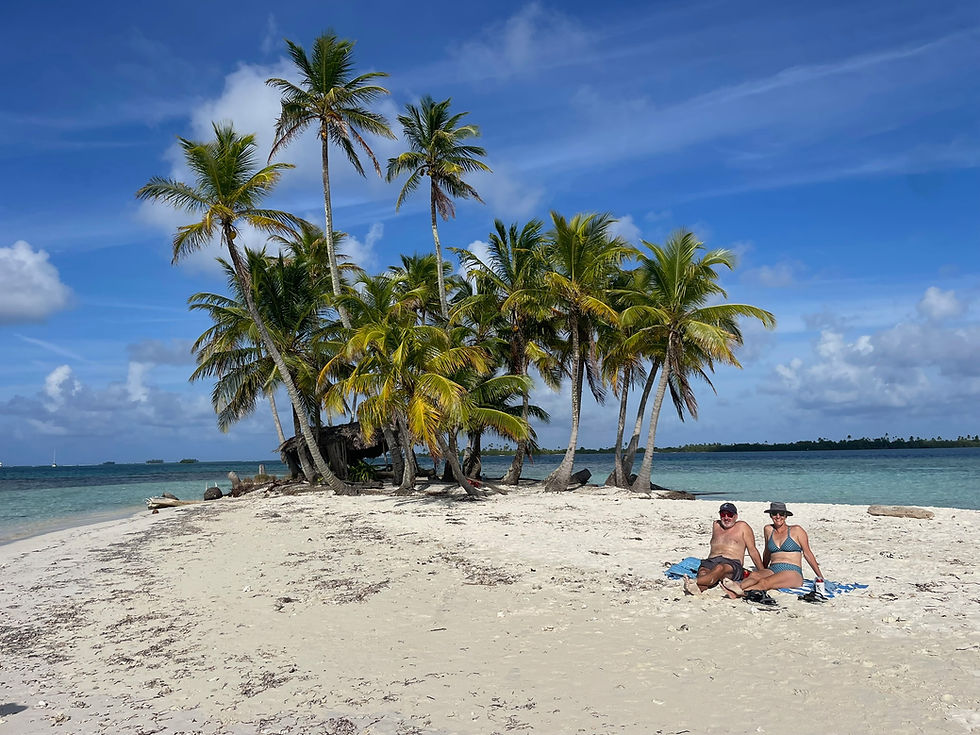
The cruising ground of the San Blas is protected by an extensive barrier reef. These shallow reefs absorb the impact of the big waves generated by the strong trade winds of the Caribbean’s dry season. The islands are low, well-spaced and small allowing for the wind to easily pass through. The result is flat, breezy sailing. Perfect! There are so many anchorages, but the “swimming pool” was one of our favorites—shallow, calm, clear water, a large ray feeding on the sand under our boat, and the sound and sights of heavy surf crashing against the reef out in the distance.
The San Blas archipelago is comprised of 350 islands, mostly uninhabited or very sparsely habited. The water surrounding these islands is very clear and the coral reefs extending around the edges offer great snorkeling. Eagle rays, nurse sharks, tropical fish of every sort, colorful and healthy coral reef extending out from the edges of these islands is stunning. Snorkeling was good exercise, super interesting, and near most anchorages. Wailsaladup anchorage had a great wall to snorkel and a walkable palm tree island with a family selling thirst quenching coconuts. The reefs do make for some tricky navigation, for they lurk beneath what appears to be vast stretches of open water. Careful attention to charts with a close eye on water color and texture are needed to avoid them.
Bocas del Toro is well protected by the mainland, a ring of larger islands and mangrove islets offering flat water with light winds. Truly champagne sailing there with lots of nooks and crannies to explore like Starfish Beach, Red Frog marina, the beaches of Isla Bastimentos, and Dolphin Bay. Just watch out for the pink meanie jellyfish(!) which nixed swimming in the calm interior waters. One of our favorite Bocas experiences was Mia’s jungle trails. We pulled up to her private dock, greeted by her exuberant 4 dogs and Mia’s warm welcome. She has great hiking trails throughout her jungle property, provides you with mud boots, walking sticks, and sends you off guided by her dogs. We found “King of Hearts” tree, “Mad Hatter” trail, beautiful flowers, giant spiders, and vast views from Mia’s deck.
The pleasant sailing and defined area where we would be for a while offered a good opportunity for us to host visitors. We were happy to be joined by Brett’s sister Pam in Bocas del Toro, Ellie and Patrick as well as friends Steve and Alyson, each for a week in the San Blas. Lam Tours provided reliable, albeit adventurous transportation to/from the San Blas and Panama City—driving them overland to the Caribbean port of Carti, with transfer to a water taxi that delivered them directly to/from our sailboat. Quite amazing to have them delivered right to us in this remote location!
The Guna Villages and Culture
Several of the San Blas islands are populated with Guna people, a very traditional society holding onto their longstanding ways of dressing, farming, and governing. They speak a local Guna dialect as well as some Spanish. The villages are generally tidy albeit crowded with tightly spaced huts made of bamboo and palm thatch roofs. A maze of dirt paths wind through the islands which are swept in the mornings. Most villages have a school, a basic health clinic, limited electricity from small solar panels or generator power, many have water piped from a stream on the mainland, but some collect rainwater. A chief leads each village in a daily or weekly meeting with all inhabitants in a central congresso building. Families cook over open fire and most homes have a cooking room, a sleeping room, an outdoor bathing room, and gardens.
The Guna are friendly and welcoming to visiting cruisers and willingly share how they live. Very often we were greeted with enthusiastic waves and smiles coming from traditional dugout canoes (ulus) that would row or sail past us. On the Carti Islands Mr G guided us during their Revolution Day holiday during which they passionately and realistically reenact the scenes of obtaining sovereignty from Panama. Pablo greeted us at Isla Mamitupu, showing us how they collect and process coconuts to make coconut oil. While anchored there, we witnessed the village men silently rowing their ulus to the mainland at the first hint of light, returning later in the day, their boats filled with coconuts and plantains after working the day on the village’s farmland. There were a lot of children--boys playing basketball or fishing from ulus, older girls keeping an eye on the younger ones, toddlers running around on the village paths, all quick to smile, say “Hola”, curious and content.
The adult women, young and old, still wear traditional mola blouses and ankle/wrist beaded bracelets. Molas are intricate and beautiful textiles made of several layers of fabric using a reverse applique technique and the skill is still passed down to younger generations. We met some true artists—Prado on Isla Miriadiadup, and Venancio who visited us via ulu in the Hollandes islands. We will return home with several molas that we purchased.
The Cruisers
This is a popular cruising ground, so we had the company of many other cruising boats. This made our stay quite social, and we were able to enjoy activities and sundowners with old and new friends throughout our stay. The San Blas morning radio net offered daily communication among cruisers and was led by Onno, of SV Lost Pearl, who we first met in pacific Panama. There are so many anchorage options, there was always a way to enjoy a few days all to ourselves as we did at Gunboat and Anmardup Islands, but other cruisers weren’t far away in the most iconic spots when we were ready for more interaction.
Helping each other out is a great aspect of the cruising community. We spent several days in the Esnasdup anchorage waiting out a 30-knot blow. Being a well-protected spot, several others were also there. Brett took the time to tackle our broken generator and was helped immensely by Dave on S/V Cavu, an electrical engineer who we first met in Costa Rica. Brett and Dave spent a good couple of days in the engine room getting the generator working again! We did our best to reciprocate the favor with homemade chocolate chip cookies and hosting Dave and Marla over for dinner and we try to help others whenever we can.
In Bocas del Toro we met a unique cruising family who lives on a catamaran that is anchored at an island property they have purchased! They are building a home, have set up a small bar and grill called the Dolphin Bay Yacht Club, and are developing a farm complete with chickens, goats, pigs, gardens, rabbits, and 2 very sweet (but mildly feral) children who gave us an entertaining tour. We were able to purchase delicious duck eggs and homemade jam.
The remoteness!
Remoteness makes the San Blas exotic and exciting. Without starlink, one would be completely off grid. The winding and hilly road from Panama City to the Carti port is one of the few roads in the area, for the mainland is dense, impenetrable jungle. The tiendas in the villages were extremely limited, so we stocked up big time prior to leaving Shelter Bay, stuffing our freezer to capacity. A family on Esnasdup sells fresh produce on their dock that they bring in from the mainland. (They will also do a load of laundry using a generator and siphon gasoline out of a barrel for outboards.) Guna fishermen sell fish and lobster from their ulus, a treat we enjoyed several times. We were pleased to discover Juan Saul, who operated a delivery business. We could order food online from a grocery store or have a boat part delivered to Panama City and Juan Saul would pick it up and deliver it directly to our boat a couple days later. He was well equipped with coolers and even managed to safely deliver fresh eggs that arrived intact! Without these few services, having enough supplies to last 2 months would have been difficult.
The remote location requires that we be quite self-sufficient. Cruising boats generally need to be able to make water, handle essential boat repairs, and be prepared for medical emergencies. This is another reason having the community of boaters around us was comforting.
The Challenges
Getting There
Sailing out from the canal zone and into the exposed waters of the western Caribbean can be tough and requires good weather windows. We headed out of Shelter Bay for the overnight sail to Bocas del Toro. The waves are crazy and confused at the canal outlet, but that is short lived. Unfortunately, early into the westward journey we encountered a strong adverse current of 2-3 knots opposing our progress. It also opposed the prevailing wind and swell, causing a buildup of standing waves that buffeted the boat erratically all day and night. At times, the steep, uncomfortable seas stalled our progress to a soul crushing 1.9 knots. This turned out to be one of our toughest sails to date, exacerbated by the fact that our sea legs were rusty for this first sail of this season and the unfortunate discovery that our overhead hatches were leaking saltwater into the boat with the frequent waves crashing over our bow. Not good! Brett replaced them after Christmas--getting the old ones out was tough job, but we now have new hatches with fresh, strong seals.
The sail to the San Blas is no cake walk either, but the conditions were as expected, and we found we were getting more accustomed to sailing through bigger waves. We enjoyed a couple nice stops along the way, including the interesting town of Portobello, Panama. This old colonial fort has well-preserved ruins, the Christo Negro (Black Christ sculpture which is the destination of a large pilgrimage each October), an excellent Italian restaurant (Casa Vela), and two of the cutest kids we’ve ever seen who just cracked themselves up trying to communicate with us gringos.
The Plastic
Plastic trash washing onto the islands from the open ocean and lack of a way of disposing with plastic generated here is a huge problem. The islands are being soiled by plastic shoes, bottles, wrappers, etc. Plastic is still getting tossed into the ocean, on the islands or into the mangroves. Some is burned. A lot just collects up. It’s a big problem and the solutions are complicated and controversial, a frequent topic among cruisers. We participated in a couple of trash burns, tried to minimize our trash overall, and took it with us when we left the area. The Guna villages do not have the resources to adequately deal with this growing problem. Isla Tigre is doing a noble job—they have signs posted raising awareness that trash should be cleaned up, reused, and placed into bins. Bins and fences are built using plastic water bottles that are tied together, which is quite ingenious.
Overall, this has been a magical few months. We were rewarded with such an interesting experience that we could only have had as cruisers. It has motivated us to continue to press on, see more, sail more, live a little more as cruisers. We are looking forward to what’s next -- Columbia and destinations of the Northwest Caribbean.


Loved the blog and photos. We did a kayak trip along the barrier islands off the southern end of Belize years ago. Your pics bring back tons of memories.
The water....Oh, my! So happy for you.